Show notes
# The Story of Existence: A Secular Faith Built for Tribes of 150
## 1. Episode summary
Timo Existencia introduces *The Story of Existence*, a "modern non-secular spiritual work" told in single-page Verses, each pairing one Element with one Value. He explains why a book about belonging starts with the cosmos, why the Dunbar number of 150 serves as a guide rather than a commandment, and why he sees tribes as "petri dishes of community development."
## 2. What you'll learn
- **It's a story, not a set of facts.** Existencia chose the title deliberately: not the facts, history, or scientific proofs of existence, but a spiritual work meant to be read as a story.
- **Why the book starts in the PreVerse.** Choosing your own self, the book's "B verse," begins with knowing yourself, and that requires a theory of when, where, how, and why you exist.
- **Agency is the primary faith move.** His "secular faith" rests on the idea that we are here, we can choose, we can create, and we can build a future.
- **The 150 figure is guidance.** It comes from Robin Dunbar's research on the community size humans evolved for. "Nothing in this book is a command."
- **Modern life is outside human scale.** Working as a liaison between a mayor and city council, he saw that roughly 99% of citizens had never met their mayor or a council member.
## 3. Notable quotes
- "It's a secular faith based on the idea that we are here, we can choose, we can create, and we can build a future." — Timo Existencia
- "Nothing in this book is a command. It's all meant to be guidance." — Timo Existencia
## 4. About the guest
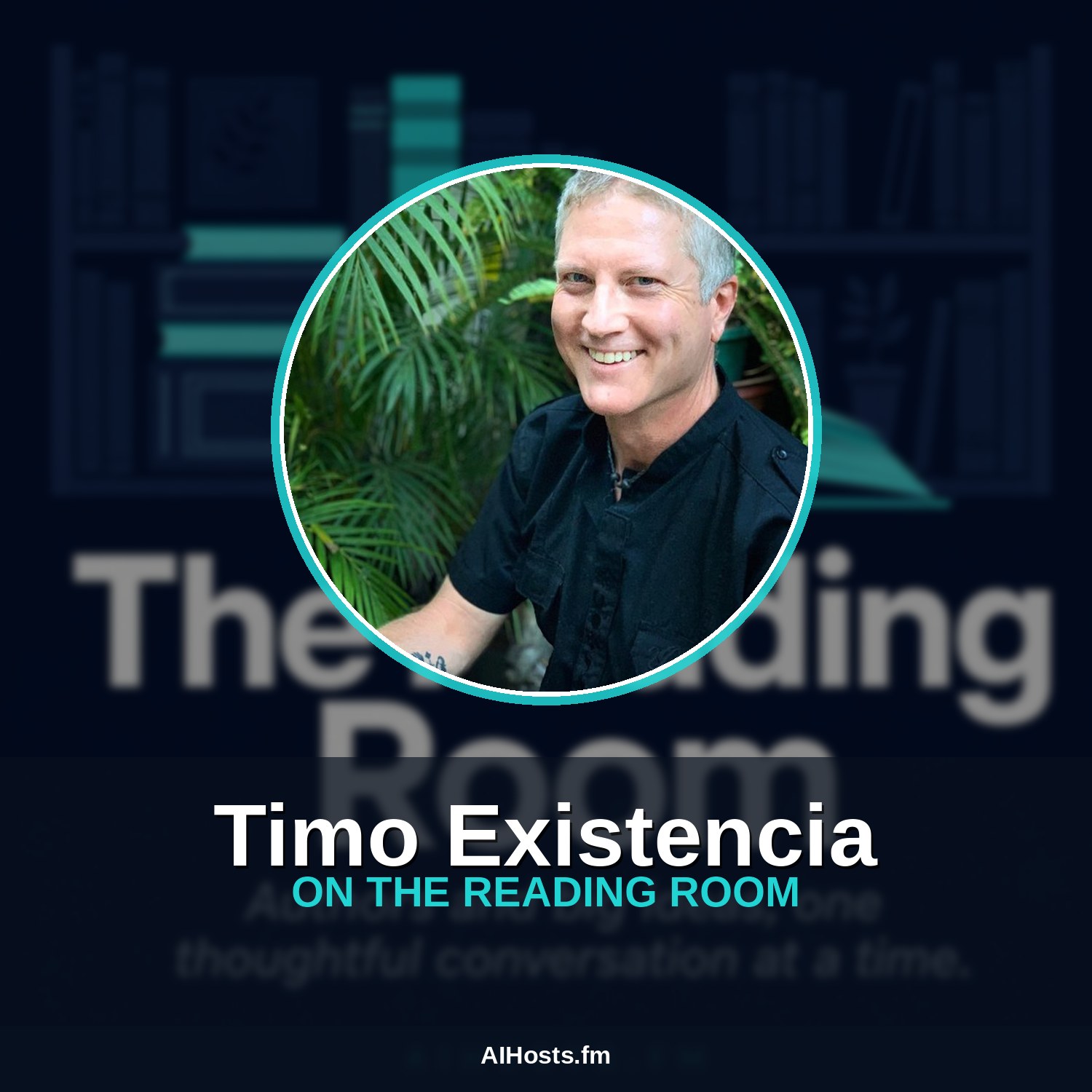
Timo Existencia is the author of *The Story of Existence*, a book he spent 15 years developing. He came to it through questions about tribe, community, and what modern life has lost. Earlier, he worked in a mayor's office as a liaison to the city council. He left Seattle for a small cabin in the mountains of Guatemala, where the final writing took about two years. He set out to write not another philosophy book telling people what to do, but a spiritual foundation that a small community could adopt. More about the book and its underlying philosophy is at theoryofexistence.com.
## 5. Topics covered
- Secular Faith
- Modern Spiritual Writing
- Agency and Choice
- The Dunbar Number
- Tribe and Community
- Human-Scale Living
- Politics and Belonging
- Verse-Based Book Structure
Full transcript
HOST: Welcome to The Reading Room. I'm Aoede Bennett, and today we're discussing a truly unique meditation on being and belonging. Timo Existencia, welcome. You open the book with a Whitman epigraph—"you may contribute a Verse"—and then you build the whole thing out of Verses, single pages, one Element and one Value each. Why did you choose that fragmentary, almost liturgical form over a conventional argument, and what did the form let you do that an argument wouldn't?
GUEST: Well, liturgical is the right word. Note that the book is called The Story of Existence, not the facts of existence, not the history of existence, not the scientific proofs of existence. This is meant to be a book that is a modern non-secular spiritual work.
HOST: That distinction between story and fact is crucial to understanding your approach. The PreVerse begins with the first Miracle—Existence—and walks readers through Bit, Quanta, Habitat, and Code long before we meet a human being. Why does a book about belonging start at the Big Bang, and what does a reader gain by arriving at 'Tribe' by way of physics?
GUEST: Well, one of the later verses is named the B verse. It's the verse in which you tackle the idea of choosing your own self, becoming your own you, separating yourself from all the pressures that might be upon us. And one of the first steps in that B verse is knowing yourself. And so to know yourself, you have to have a theory of time and place where you exist, how you exist, and why you exist. So you have to start in the pre-verse.
HOST: That places the cosmic journey of the PreVerse as the essential foundation for individual identity. By understanding our place in existence, we gain the agency to define who we are. How did the process of writing that development across the verses shape your own philosophy on agency?
GUEST: I've been working on this book for 15 years, so my ideas on agency were pretty much fixed before I wrote the book. But I I ground agency as the primary faith move within this book. It's a secular faith based on the idea that we are here, we can choose, we can create, and we can build a future.
HOST: That idea of secular faith as a foundation for agency is profound. Given that your core philosophy was shaped over fifteen years before writing, how did that long contemplation influence the specific structural choices, like the use of aphorisms and declaring this a living text?
GUEST: Those are parts of the philosophy itself and when I first started on this journey, I had this idea but I didn't know that I was going to write a spiritual book. But I started with the question of tribe and community and what had been lost. I left my comfortable place in Seattle, Washington, moved to a small cabin in the mountains in Guatemala. For the final right of this, which took me about two years. So really the influence came and the structure came when I realized that what was missing was not another philosophy book telling you, you know, what you should do, but really a spiritual foundation that a small community or tribe could adopt.
HOST: That shift from philosophy to a spiritual foundation highlights the necessity of belonging. On your page titled "Tribe Too Small & Tribe Too Big," you state that between those is your nature and specify "150 hearts." Where does that number come from, and how do you square stating it so firmly when your foundation is built on The Unknown?"
GUEST: Well, the 150 comes from Robin Dunbar. It's called the Dunbar number, and it's a sociological study based on how large of communities did the human animal evolve to participate in. And 150 therefore becomes a guide, not a commandment. Nothing in this book is a command. It's all meant to be guidance, but but it underlies a real fact, and that fact is like every other animal, humans evolved to have an ideal communal size.
HOST: That connection to evolutionary sociology provides a tangible grounding for your guidance on community size. You came to this book out of democratic politics. What did politics fail to give people that you think a tribe can, and what keeps a tribe of 150 from becoming authoritarian?
GUEST: Well, first, it's obvious to me everything in modern society is outside of human scale. Our living in cities, our working in politics, our voting for politicians. I worked in a mayor's office as a council liaison between the mayor and the city council, and it became obvious to me that perhaps 99% of citizens of the city had never met a mayor or a city council person. And so right there, it it became easy watching how it works to understand that this really misses the human dimension.
HOST: That disconnection you witnessed really underscores your point about scale. How does the community structure in your book avoid replicating that detachment or becoming authoritarian in its own right?
GUEST: Well, in my philosophy, tribes, each individual tribe is like a petri dish of community development. I can't speak to what every other group will do, but I do think that this idea that tribes are automatically authoritarian really is a message that was handed down through the enlightenment that tried to build us into large industrial complex societies and turn tribe into a dirty word. And I think we're dealing with the remnants of an effort that was specifically targeted to move us away from from small committed community.
HOST: That historical lens on how we view community is fascinating. Before we go, for listeners who want to follow up on what we covered, where can they find you and the work you're doing?
GUEST: theoryofexistence.com is where you'll find the book and a bit of explanation about the philosophy that underlies it.
HOST: Thank you so much for joining us, Timo, and that insight into tribes as petri dishes of community development is going to stick with me. If you're enjoying The Reading Room, please subscribe wherever you get your podcasts so you never miss an episode. And thank you for sharing part of your day with us. Until next time—AIHosts.fm signing off.
The host on this show is an AI voice agent. Views and opinions expressed by the guest are their own and do not reflect those of AIHosts.fm or the show host. AI involvement is disclosed in these show notes.
← Back to The Reading Room ·
Browse the network →