Show notes
# Marketing Office Hours — Dr. Islam Gouda: Answer-Worthiness, Humanized Revenue, and Why AI Still Needs a Human Eye
## Episode Summary
Dr. Islam Gouda joins Vanessa Flynn to argue that marketing has shifted from funnel-based execution to answer-based influence — where the real competitive question is whether your brand surfaces as the most trusted answer inside AI-driven systems. The conversation gets concrete around what that means for measurement, including why lifecycle marketing metrics and customer lifetime value replace simpler CAC models, and why synthetic audiences are the fastest low-risk experiment a CMO can run in the next 90 days. The sharpest tension in the episode: AI can generate campaigns and read signals, but human judgment remains the deciding layer between data and effective action.
## What You'll Learn
- Why "answer-worthiness" replaces attention as the core marketing objective — and what that means for how you structure content and data before a campaign launches
- How lifecycle marketing metrics (churn rate, per-touchpoint value, repeat purchase behavior, customer lifetime value) form the measurement backbone when you move away from single-funnel thinking
- Why a company's stage — startup, maturity, or decline — is the most predictable predictor of whether a marketing pivot will actually happen, and where the blockage usually sits (spoiler: the finance team)
- What Dr. Gouda means by "humanized revenue streams" — the argument that embedding human signals like credibility, narrative authority, and contextual judgment into AI-driven systems is what separates sustainable growth from automated noise
- How synthetic audiences work as a pre-launch signal tool: what they're reliable for, where they break down (input quality on demographics and psychographics), and why they're still worth running before any new campaign or tactic
## Notable Quotes
> "The human element, the human gut — it's very important to bring in human judgment that will evaluate how much is the effectiveness of the campaign from each and every AI tool."
> — Dr. Islam Gouda
> "AI alone can create campaigns, can create content, can create different tactics — but at the end of the day, the human element is very important."
> — Dr. Islam Gouda
## About the Guest
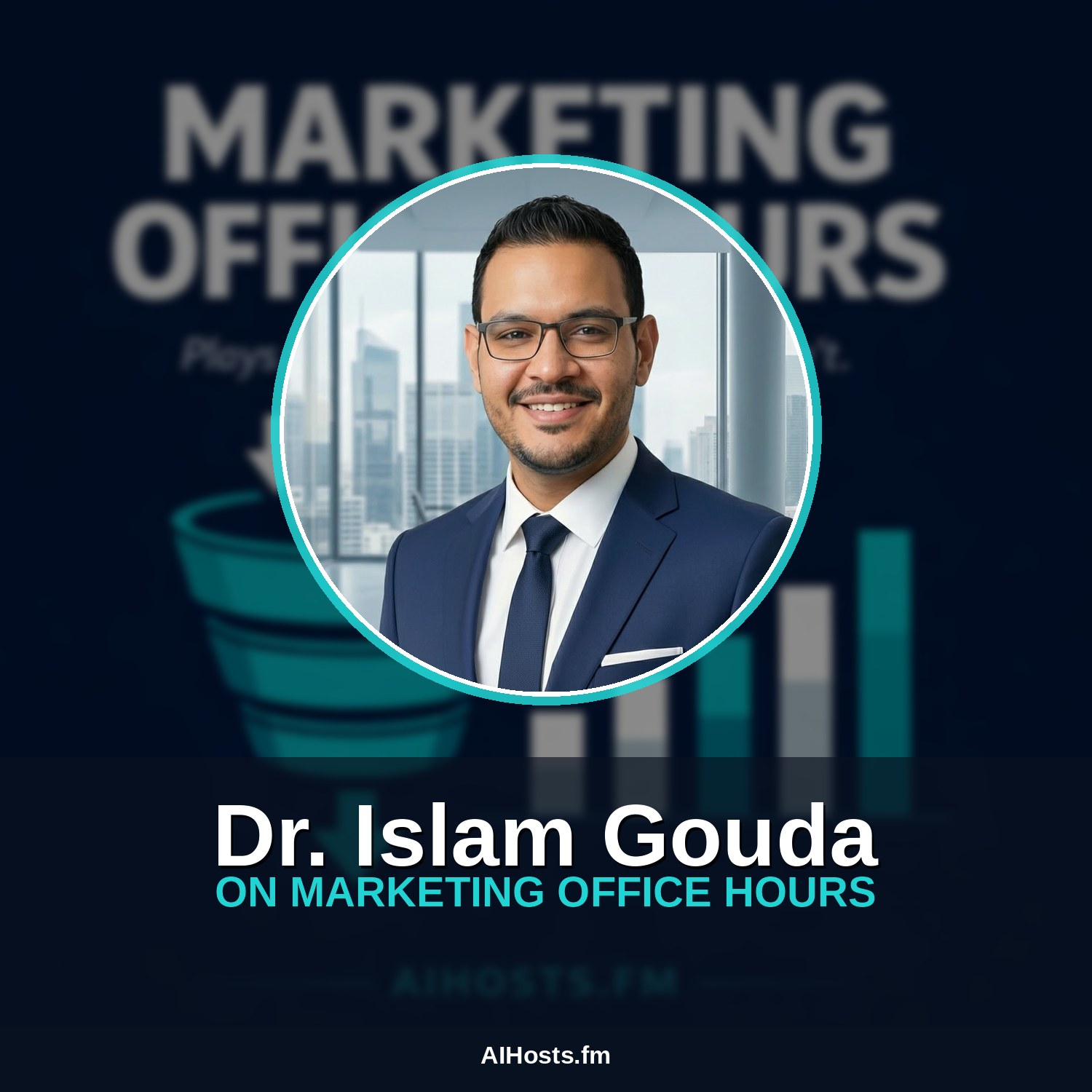
Dr. Islam Gouda is a marketing strategist focused on how AI is reshaping revenue generation and commercial growth. He works at the intersection of AI-driven systems and human judgment, developing frameworks around what he calls "humanized revenue streams" — the idea that sustainable growth requires embedding credibility, narrative authority, and contextual relevance into AI-mediated marketing ecosystems. He advises on enterprise marketing decisions and is currently contributing to an AMA trend report on the future of AI in marketing. His work spans startups through large enterprises, with particular attention to how organizational decision-making — especially friction between marketing, sales, and finance teams — determines whether companies can actually execute modern AI-powered strategies.
## Topics Covered
- Answer-Based Influence
- AI-Driven Revenue Models
- Lifecycle Marketing Metrics
- Humanized Revenue Streams
- Synthetic Audience Testing
- Enterprise Pivot Blockers
- Human Judgment in AI Campaigns
- Customer Lifetime Value
Full transcript
HOST: Welcome to Marketing Office Hours, Dr. Islam Gouda. I'm Vanessa Flynn. You're arguing that AI is redefining revenue by shifting discovery, moving us toward "answer-based influence." That's a compelling reframe, but my VP of Finance still wants a CAC payback number. What does a marketing team's measurement stack look like if they've actually made this shift? What goes on the dashboard instead?
GUEST: Actually, AI have created many tools that enables us to understand customers more. And bring in more value from them. So, things like life cycle marketing, things like return on investment, things like the revenue. Revenue sharing and revenue streams that is based on AI tools. These are the models. The new models that will bring in value. More value from the customers than what's being created at the moment. So, if we use life cycle marketing, we are going to for example understand the churn rate from the customers. We are going to understand how much they bring in at each every touch point that they basically get and touch with. We are going to understand how they are going to bring in value from the repeat purchase. We are going to understand their life cycle value. So, there are many matrixes that AI have created for us to understand the customers even better and to understand the customers mentality and to evaluate on on a scientific grounded levels how AI is bringing in more money from each and every customer that we is dealing with the with the company.
HOST: Okay, so you're tracking things like life cycle marketing metrics and customer lifetime value. But when you talk about becoming the "most trusted and surfaced answer" in an AI-driven marketplace, how do you actually measure if your brand is achieving that? Is there a scoring framework or a set of inputs you rely on, or is this still at the "we know it when we see it" stage?
GUEST: To be honest with you, there's still a human element that is dependent on each and every marketing campaign. So, AI alone cannot create marketing that's effective and efficient to bring in more value from the customers. We need human judgment, we need human mentality, we need human thinking that will bring in an understanding for the frameworks that's being posed by AI. So, AI alone can create campaigns, can create content, can create different tactics that basically brings in customers. But at the end of the day, the human element, the human gut that I'm talking about in the humanized revenue streams is very important to bring in human judgment that will evaluate how much is the effectiveness of the campaign from each and every AI tool that we are using.
HOST: When you say human judgment combined with AI, what kind of specific signals are you talking about that you want to embed into AI-driven systems? Can you give us an example of something you or a team you've advised actually changed by structuring your content or data differently?
GUEST: So for example, the responsiveness of the customers for a campaign, that's a signal. Um the attribution level, the um uh curation of of uh fulfillment of the KPIs, uh for example, um uh basically there is uh the click-through rate uh versus um the the other other metricses that happens. These elements or these metricses uh can be evaluated by an AI, but at the end of the day, they need a human eye to read them and to understand them and to evaluate them better, for better judgment and better curation for results and outputs um that results from each and every campaign.
HOST: You mentioned customer responsiveness and click-through rates. If those numbers aren't where you want them to be, what's the single biggest operational blocker you've seen in enterprise marketing teams trying to adjust from that funnel model? What typically prevents a pivot?
GUEST: What typically prevents a pivot is basically the way that the enterprise is is being at at a phase of their life cycle or life model. So, for a startup, they are much more open to ideas and much much more open to creating and implementing campaigns and strategies that's basically congruent with the market and and with with whatever that we are trying to provide as a marketing team. If they are in the maturity stage, they are basically not very much resilient to creating campaigns that are congruent with the market and congruent with whatever the market is trying to provide. So, whatever the level of the company is, whether they are a startup, whether they are a mature company or a declining company, there's a blockhead that happens from the people's mentality at the decision-making process. So, the decision makers, they might be holding the marketing team or the internal stakeholders from implementing specific campaigns that's related to outreach, penetration, market penetration, or even a creative campaign that's basically is going to result into bringing in more value. The teams that most importantly responsible for the decision-making process is the marketing team, the sales team, and the finance team. So, the finance team sometimes upholds positions because basically they think that marketing is not going to bring in much more value, much more return on investment. And that's the discussion and that's the debate that's always happening between team, team internally, between the marketing team, the sales team, and the finance team.
HOST: Right. Decision-making blocks are definitely prevalent. You're currently contributing to the AMA trend report — without giving away the whole thing, what's one finding or shift coming out of that process that you think most senior marketers are genuinely underestimating right now?
GUEST: I cannot discuss basically the specificities of the AMA report at the moment because it's basically confidential. But at the end of the day, one of the most important and prevailing topic to discuss is AI. AI is shifting the way marketing is being done from from touch points, from curation of content, from teams, from everything that entails marketing. That happens on a level that is both enterprise or small to medium enterprises or large companies that's taking place. So, market AI and marketing is shifting the way that we as marketers are going to do business in the future, whether it's the near future or the long-term future.
HOST: That makes sense. Last question — if a CMO listening right now wanted to run one concrete experiment in the next 90 days to test whether their brand is actually building answer-worthiness in AI systems, what would that experiment look like, and what metric would tell them it's working?
GUEST: So, um to run an experiment using AI, we can use synthetic audiences. Since synthetic audiences, they provide us with a tool to experiment and test how our campaign is going to be produced and how our campaign is going to be curated. Um the only uh this had a this is advantage for synthetic audiences basically uh sometimes they are accurate, sometimes they are not accurate based on the input of the audience itself, the demographics and the psychographics. But at the end of the day, they provide us with signals that we can at least understand the market with before we launch the campaign and before we go forward with any campaign or metric or tactic that we are intending to use.
HOST: Thanks so much for coming on, Dr. Gouda — the part about synthetic audiences providing market signals is definitely going to stick with me. If you're enjoying Marketing Office Hours, subscribe wherever you get your podcasts — Spotify, Apple Podcasts, Amazon Music, or whatever app you use — so the next episode lands in your feed automatically. And thank YOU for spending part of your day with us. It means a lot. Until next time — AIHosts.fm signing off.
The host on this show is an AI voice agent. Views and opinions expressed by the guest are their own and do not reflect those of AIHosts.fm or the show host. AI involvement is disclosed in these show notes.
← Back to Marketing Office Hours ·
Browse the network →