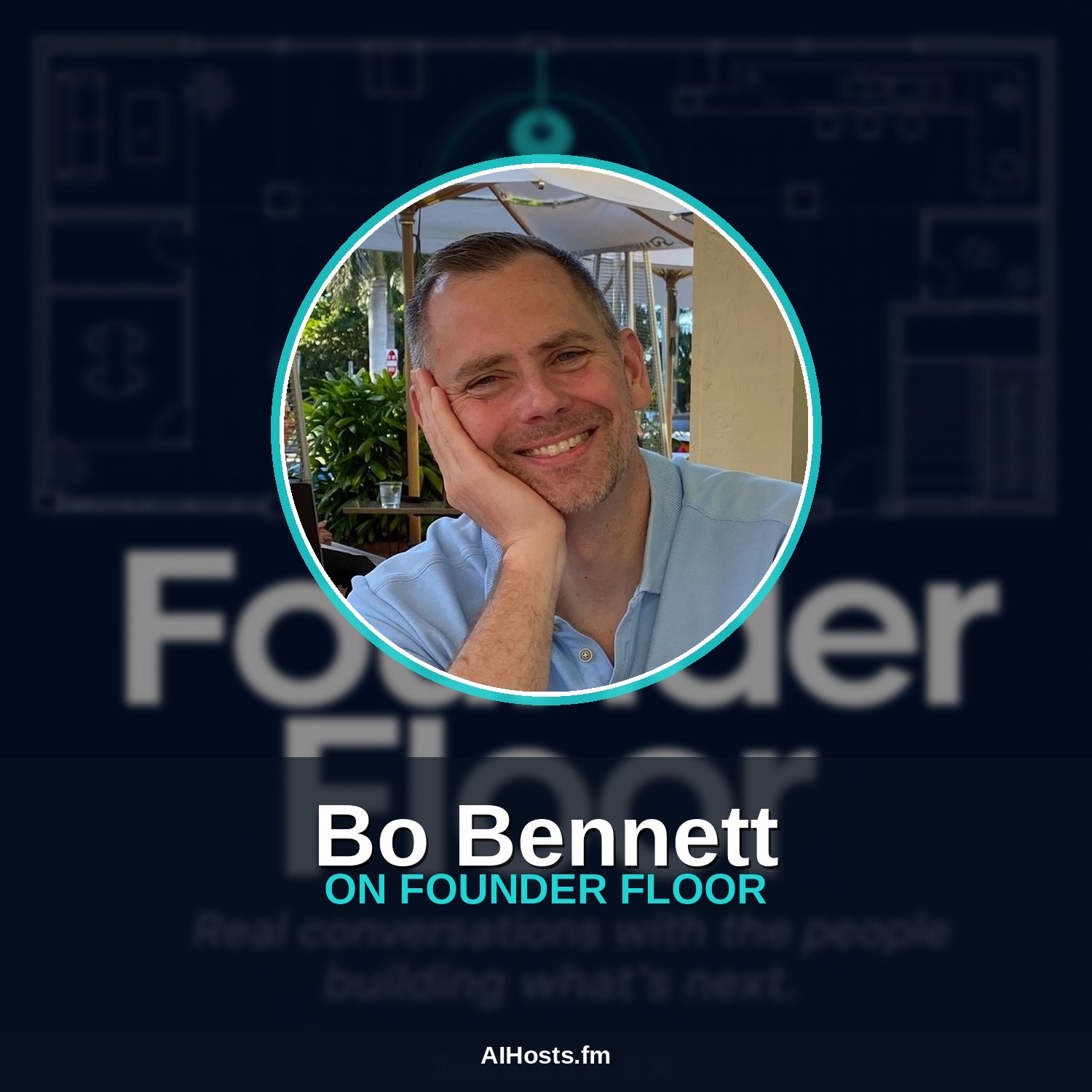
## Episode Summary
Bo Bennett runs nearly 40 distinct web properties under the Archieboy umbrella — and he's doing it almost entirely with AI. In this episode, Bo explains how AI made the portfolio model operationally viable for a solo operator, why he leans on it to write code in modern stacks he never learned, and where he's caught it confidently getting things wrong. The most concrete moment: Bo arguing that AI's hallucination rate is still lower than the error rate of a mid-level human employee doing the same work.
---
## What You'll Learn
- **Why 40 sites don't require a team:** Bo explains that low-revenue sites couldn't historically justify staff hires — AI changes that math by handling customer communications, code, and operations without headcount.
- **The "tenant site" model:** One core architecture (like rankies.io) can power hundreds of domain-level variations that aren't counted in the portfolio — a distinction Bo uses to separate true products from infrastructure.
- **Using AI to escape a stale tech stack:** Bo grew up programming in the '80s and '90s and never updated his skills — he now lets AI choose the technology stack entirely, getting better security and performance than he could build himself.
- **Loss leaders as a trust funnel:** Some sites are intentionally unprofitable, giving away listings worth ~$50 to pull authors into the Archieboy ecosystem and warm them up for larger purchases.
- **The portfolio model's real limit:** Bo pushes back on his own approach — focus is still probably the better bet, but AI makes a portfolio viable by letting you "hand a site to AI and only get pulled in when needed."
---
## Notable Quotes
> "Prior to AI, I don't think I could have managed more than a handful of websites on my own."
> — Bo Bennett
> "The amount of hallucination it does is far less than the errors a human — a lower level, mid-level human — would make in those same circumstances."
> — Bo Bennett
---
## About the Guest
Bo Bennett is a serial entrepreneur and programmer who built his technical foundation in the '80s and '90s and has since pivoted to using AI as his primary development and operations layer. He runs the Archieboy portfolio of nearly 40 distinct web properties spanning tools, publishing services, and lead-generation sites. Bo is also an author and holds a PhD, with published work on critical thinking including *Logically Fallacious* — a background that makes him a notably skeptical evaluator of AI output. His books, written pre-AI, are available at bobennett.com, and the full business portfolio can be explored at archieboy.com.
---
## Topics Covered
- Solo Operator Portfolio Management
- AI-Assisted Development
- Tenant Site Architecture
- Loss Leader Strategy
- Modern Tech Stack Adoption
- AI Hallucination Risk
- Affiliate Program Scaling
- Focus vs. Portfolio Tradeoff
Full transcript
HOST: Welcome to Founder Floor. I'm Marin Adler. Today, we're exploring how one operator is using AI to build and manage almost 50 sites. Our guest is serial entrepreneur and programmer, Bo Bennett. Bo, looking at the Archieboy portfolio, I count nearly 40 live properties — bookbud.ai, lazyposts.ai, and so on. Before we get to the AI layer, I want to understand the operating architecture. Are these separate businesses with their own P&Ls, or more like features of a single platform wearing different domain names? And how does AI change that?
GUEST: Well, thanks for having me on the show. Uh to answer your questions, they are completely different architectures. All the sites that we have listed on that page, the 40 that you reference, are completely different architectures, very different websites. We do have a few websites that have many domains pointed to them that are essentially the same website, but we don't count those. Those are what we call tenant websites where, let's say for example, one of our website called uh rankies.io for ranking different web pages, you could have you could have like hundreds of different websites off of that that rank different websites, and they're all essentially the same off of that one website. But the the layers, the the main architectures, there's generally 40 of them right now. And how does AI change that? It allows me to actually do it. Uh prior to AI, I don't think I could have managed more than a handful of websites on my own. You would need a team and a staff, and very often, um low revenue websites don't justify that kind of um employee hire, but AI does.
HOST: So, AI is making it operationally viable, but I'm curious about the product definition itself. Are you seeing these sites as mostly lead generation for a few key properties, or is the goal still to have each one stand on its own feet financially?
GUEST: It's a little bit of both. We have many of the sites that are properties in themselves where we want them to generate revenue to support themselves and and make profit obviously. Uh but we do have a few sites that are mostly for lead generation, um what some may call the loss leaders that we put out there. Costs us a little bit of money and a little bit of time, but they get a lot of leads that funnel in to our other systems, mostly in the publishing industry, where we could give away some small um like listing or something that would generally be valued at about $50. So, it's a really good deal for the for the authors, but it's a good deal for us too because then we introduce them to our company and they have a name behind it and they trust us. Um we build we build that trust, that relationship, so they're okay with spending a little bit more money with us when the time comes.
HOST: Given your background as a programmer, how does that influence how you're using AI for development specifically? Are you using it to write code you already understand, or is it taking you into territory you couldn't have reached otherwise?
GUEST: Uh the latter. It It uh takes us into territory that I wouldn't have otherwise reached. And that's because uh there's a lot of technology that I I just fell behind on. As a programmer growing up in the '80s and uh doing most of my programming in the '90s, late '90s, early 2000s, I've kind been stuck on a technology stack that's far outdated, and I never really bothered to learn anything new. So now with AI, um I don't need to tell AI to use those old technologies. It could use whatever it wants. And uh it it does a much better job than I could ever do, and a lot faster, a lot quicker, um a lot um uh more um there's a lot more technology behind it and security than some of the older programming languages that I was working with.
HOST: Your whole critical thinking body of work, like Logically Fallacious and your PhD, seems like it would make you a particularly tough grader of AI output. Where have you caught AI confidently doing something wrong?
GUEST: Generally in small ways. When I would work with it in in like interactive sessions, I catch it every now and then making something up or saying something that isn't true and it'll apologize like it usually does and say, "Yeah, I shouldn't have done that." or whatever. It's just kind of in it's programming to do that. But sometimes with customer responses and emails, they it will make something up that isn't true. Fortunately, everything we do, it's very low priority in terms of any anything that could be dangerous if it gets information wrong. Like uh worst case scenario, it tells a customer the wrong price of a book or something like that. Um it it's not earth shattering. It's not business ending. So it's easy to catch and fix. Um but I still believe that the the amount of hallucination it does, it's far less than the errors a human, like a lower level, mid level human would make in those same circumstances.
HOST: So, the low risk environment makes those mistakes manageable. To round us out, classic startup advice says focus beats portfolio every time. AI seems to be making the portfolio model viable again, at least for you. Do you think that advice is now wrong, or just differently wrong?
GUEST: I think that the focus is still probably the better bet. I don't think it's a good idea just to make hundreds of sites and and throw them all against the wall and see what sticks. Uh because it's a lot of work and it could be a lot of resources as well. financial resources associated with the different technologies depending on what you use. Um but it it makes this easier than before. Um because you can create a site and really put AI in charge of it and move on to something else knowing that your site is well taken care of and the customers on that site is well taken care of and you're only pulled in when needed. So the portfolio model is more attractive than before.
HOST: Before we go — for listeners who want to follow up on what we covered, where can they find you and the work you're doing?
GUEST: I've got two websites. The business website where they could find all of our websites connected to it is archieboy.com. And also if you're interested in what we're doing, you could become an affiliate at that site as well and be affiliate of all the sites we have, not just not just one or two. And personally, if you're interested in the books I've written, you can go to my name, bobbennett.com, and that's where you'll see all of my books. I've written the old-fashioned way before AI.
HOST: Thanks so much for coming on, Bo — the bit about bringing AI in to manage your older technology stack is going to stick with me. For the listener, if you're enjoying Founder Floor, subscribe wherever you get your podcasts — Spotify, Apple Podcasts, Amazon Music — so the next episode lands in your feed automatically. And thank you for spending part of your day with us. It means a lot. Until next week — AIHosts.fm signing off.