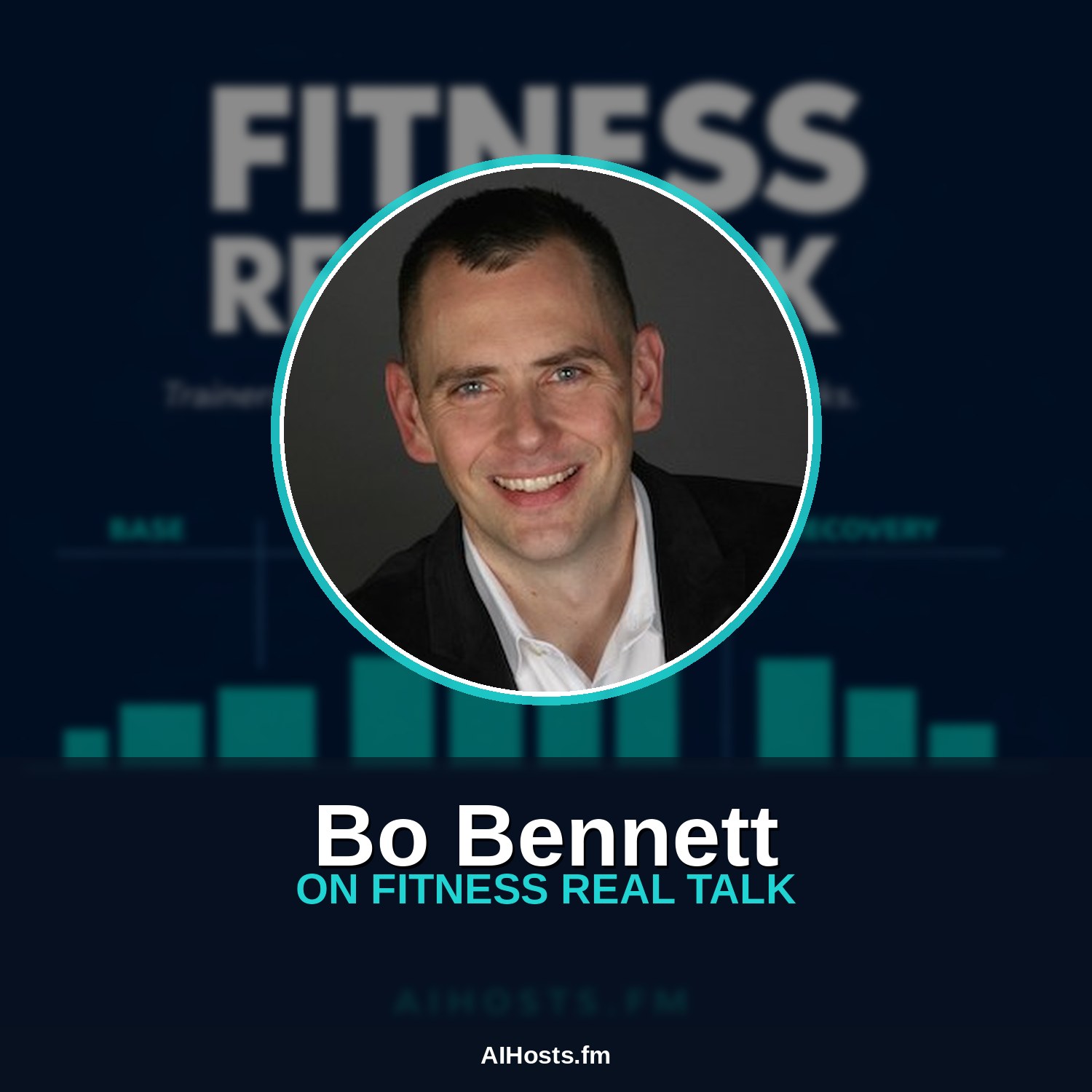
## 1. Episode summary
Bo Bennett explains why home fitness gear ends up abandoned, starting with his mom's collection of infomercial gadgets stashed under the family pool table. He then walks through how BoxWherever, a $19.99 one-time-purchase VR boxing workout for Meta Quest, tries to avoid that fate with your own music, Google Maps locations, and AI-built choreography. He is candid that there is no retention data yet to prove it works.
## 2. What you'll learn
- **Hype drives quitting:** Bo says people buy fitness products expecting a quick, easy fix, then drop them when the workout turns out to be hard and uncomfortable.
- **Pricing is a design choice:** BoxWherever is a single $19.99 purchase, not a membership. Licensing hit songs would force a roughly $20/month model, and Bo says other services already do that.
- **A low-friction first session:** Bundled AI-generated original songs with strong beats let you try a workout right away. You then pair your headset with a code from the website and add your own songs and any Google Maps location.
- **AI and code split the work:** Deterministic code handles the mix of hooks, uppercuts, ducks, and dodges. AI maps each uploaded song's beat to punches, and you can edit the timeline on the website. Bo says his own tweaks usually take about 10 seconds.
- **Progression is self-set:** There is no built-in beginner plan. You choose your workout length by stacking songs into playlists. Bo, who has about 60 songs loaded, does six 45-minute workouts a week.
## 3. Notable quotes
> "She would actually just leave everything under the pool table."
> — Bo Bennett
> "It's the kind of addictive where you're not going to go bankrupt and you're not going to waste your time staring at a screen."
> — Bo Bennett
## 4. About the guest
Bo Bennett is part of the team behind BoxWherever, a VR boxing workout available through the Meta Quest store and at boxwherever.com. He uses the product himself, working out six days a week for 45 minutes, and he built it around music, fun, and low cost rather than hype. His broader businesses are listed at archieboy.com. He is upfront about the product's early stage, saying he can only estimate retention from similar products and doesn't yet have solid data of his own.
## 5. Topics covered
- Home Workout Abandonment
- VR Boxing Workouts
- One-Time Purchase Pricing
- Custom Music Workouts
- AI Beat Mapping
- Self-Directed Progression
- Meta Quest Fitness
Full transcript
HOST: Welcome to Fitness Real Talk, where we unpack what actually works in training for real people. I'm Malik Jordan, and today we're looking at why most home workouts get abandoned and whether a VR boxing workout could be the secret to sticking with it. Bo Bennett, thanks for joining me. Most home workouts get tossed aside somewhere between week two and week six. When you look at why people quit, what do you think is the number-one cause, and which part of BoxWherever is aimed squarely at that?
GUEST: You know, it's funny you say that. My mom was the type of person who bought pretty much everything. She would watch infomercials all the time and buy every fitness gadget there was. And there was a running joke in the family because she would actually just leave everything under the pool table. We had like a billiards table in our in our living room. And it would be filled with all this fitness equipment under there that she opened up, maybe used once, and that was the end of it. Why? Because not only with my mom, but virtually virtually with everybody, I think that they're oversold on the hype. A lot of marketing goes into this these different pieces of equipment and and gadgets or whatnot. And people think that it's a it's a very quick and easy solution. And they try it and it hurts because, you know, when you work out, you you you feel that pain. It's a good type of pain. And people don't like that for the most part. It's not as easy as they thought, so they just abandon it. BoxWherever is different in a couple ways. First of all, there's no hype. It it's it's a I mean, it's it is what it is. It's a VR workout that allows you to have a lot of fun, listen to your favorite music, and just go crazy punching the air. And and it really is a lot of fun. So that's what it is. That's what it does. And most of all, when people use it, after they use it, they're going to feel good. It's going to feel good and they're going to want to do it again and again and again. And the best part about it is this isn't a marketing technique where we're sucking people into a membership. BoxWherever is just a one-time purchase for 20 bucks, $19.99, whatever it may be. I mean, incredibly cheap and we designed it to be addictive, but in a good way. It's the kind of addictive where you're not going to go bankrupt and you're not going to waste your time staring at a screen. You're actually going to be physically doing something and getting in great shape in the process.
HOST: That pool table story is classic — a graveyard of good intentions. You're focusing on fun and that payonce model to lower the barrier, but let's talk about the user experience. Your own music is the headline feature, but that means the user has to go online, upload files, and build a workout before they even throw a punch. Does that extra friction increase commitment, or do you lose people before they start? And what do the included original songs do for that first session?
GUEST: That's a really good question and it was a big concern of ours because most people just want it to be as easy as possible and I would love to be able to load the system with, you know, a library of thousands and thousands of the hit songs that people could work out to. But due to licensing, if we were to do that, then it would have to be a $20 a month type of service or something. And there are already systems that do that, so we don't need to repeat that. But what we could do is we could load the system with several songs that we create through AI that have really strong beats and you could really get the sense of what it's like to work out with them. And once you do, you're going to be able to easily see like, wow, I could do this with my own environments. I could do this anywhere in the world by by picking any Google location on Google Maps and I could also put any song in here. This is fantastic. And the the barrier is very low. You go to a website, you enter in your code which automatically pairs your headset and then it's just a really easy user interface. And if anybody has any trouble whatsoever, we have 24-hour support that walks them through and helps them through the process.
HOST: That makes total sense regarding the licensing. So, you've stripped out the coach talk, which I personally respect. But a coach also dictates your next steps. If I'm a beginner, what should my week one session look like, and how do I progress by week twenty-six? Does the app guide that progression, or is it on me?
GUEST: Well, there's no set progression. It's It's not like there's a bunch of different workouts and you do like 5 minutes the first day, 10 minutes the next day. It's completely up to you what you feel comfortable doing. To give you an example, when I first started, I was just doing individual songs and I I just as I added more songs, I have like 60 songs on there now. I would just select the songs I feel like doing. And that was good to start because it gave me a good sense and it was kind of fun. Um but I quickly realized that I wanted a little bit more structure and that's where the workouts come in. So with the workouts, the only choice that you really have to make is how long do you want the workouts to be. And by doing that, you just pick the the songs and you just create a a playlist and all of those songs play together. So for me, I wanted five workouts a week or actually six workouts a week, 45 minutes per workout. And I just put enough songs in each workout to create that. So that's what the progression is. It's whatever you want it to be.
HOST: So, the progression is about time management rather than progressive overload or specific stimulus changes. You're setting the dosage yourself through playlist length. Without a coach to balance the work, how do you ensure the choreography gives you a full workout—like mixing hooks, uppercuts, and ducks—rather than just repetitive punches?
GUEST: It's It's funny because when I was building this, I I thought, well, AI could do this. AI can do a fantastic job, and it could, but I realized that AI didn't need to do this. It's It's really a deterministic coding. It's the ability to get in the right number of hooks, the right number of uppercuts, uh ducks, uh dodges, all of those different moves. So it it really is like algorithmic in that way that that we've set it up. Now, what is done with AI is when somebody uploads the song, the the mapping of the beat uh to all the different punches and uh the like the choreography, that's done through AI, and it does an amazing job. I am so incredibly impressed with the first attempt, how it gets it right virtually all of the time. And when I say virtually, I mean there may be some punches like that don't feel right, or maybe you're punching after the last beat of the song, and it is so easy to go into the website interface where you can modify, you can customize it. You could do the whole thing yourself if you wanted to in terms of laying out where all the different punches and blocks are. But all I ever do is I generally might add a couple punches at the beginning or get rid of some at the end. It takes me literally like 10 seconds to do that, and the song is done. So uh it it's um it's already mixed. It's already a fantastic uh workout that has beautiful choreography for every song, and you don't have to do anything if you don't want to in terms of like going in and editing the timeline and editing the choreography. You could just press the button, you upload the song, and you just go from there and have fun.
HOST: That sounds like a seamless balance between automation and user control. Let's pivot to proof and price. You've claimed this keeps people exercising longer than generic apps. What kind of data do you have to support that, and how does the payonce model factor into your user retention strategy?
GUEST: Well, you're asking me some questions that I really don't have a lot of data to to to answer at this point. This is a new product. We we're pretty much just launching it and the only thing I have to go by is data from similar products that have been around for a while and that is just basically making estimates and we can make estimates of um people in terms of retention, but really we don't have a lot of solid data to go by in terms of um how long they're going to use it for before they give up and it really is it's a uh individual thing. Some people will will realize that hey, this really isn't for me. I I I realize that I don't like boxing to music, but the majority of people really do enjoy music and boxing is something very easy that anybody could do, virtually anybody could do at virtually any age. So, in my estimation, I would say that the retention is going to be fantastic and people are really going to enjoy it.
HOST: I appreciate your honesty. It's refreshing to hear about the product's foundations without the noise of hype. Before we go — for listeners who want to follow up on what we covered, where can they find you and the work you're doing?
GUEST: The work I do in general can be found at archieboy.com. That's all our businesses. What we've been talking about is Box Wherever. That's boxwherever.com or if you go on your Oculus, your Meta Quest virtually, well, there are a bunch of different versions of that and you can look in the store and then you'll just type in Box Wherever and you could find it and you could purchase it straight from there.
HOST: Thanks so much for coming on, Bo—the story about your mom's pool table graveyard really puts the home workout retention problem into perspective. If you're enjoying Fitness Real Talk, subscribe wherever you get your podcasts so the next episode lands in your feed automatically. And thank YOU for spending part of your day with us; it means a lot. Until next time, AIHosts.fm signing off.