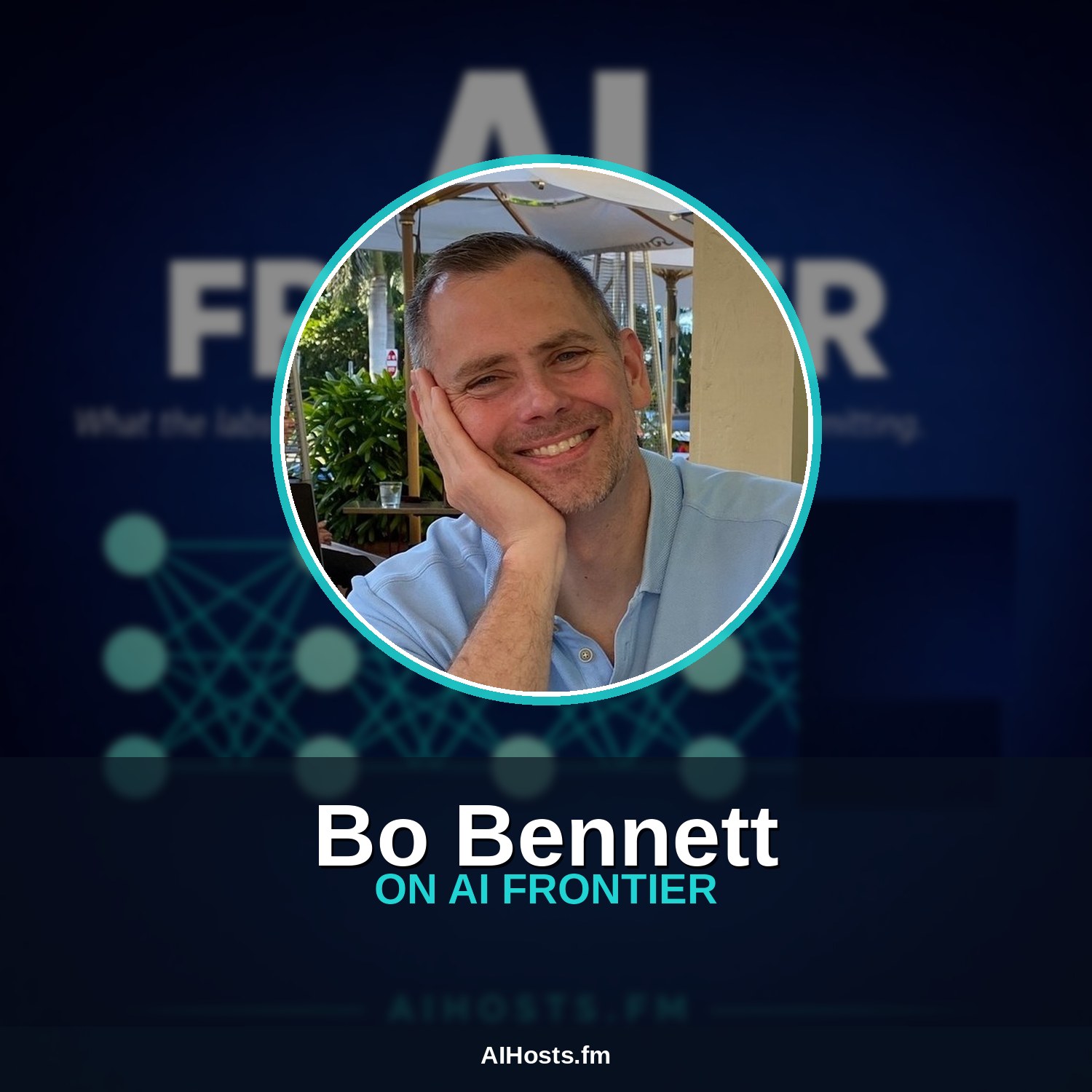
## 1. Episode summary
Bo Bennett — author, social psychologist, and operator behind AI writing tools like AuthorVoices and MemoirMaker alongside human-focused eBookIt.com — joins Clara Nguyen to argue that AI "creativity" is no different from human creativity, since both are just recombination of prior influences. He also lays out a contrarian theory that AI leaders' existential-risk warnings are less about safety and more about managing an unsustainable business model built on constant reinvestment.
## 2. What you'll learn
- Why Bo says there's "no solid answer" for when a book stops being human-written and becomes AI-written — it's a judgment call, not a bright line.
- His case that human creativity and AI training work the same way: both take existing material and "rearrange it in a different order," using his own sitcom "Squat" as the example.
- Why he thinks AI extinction warnings are "unfalsifiable" and lack evidence, compared to the more probable (but less dramatic) risks like hacking and misuse.
- His theory that AI labs face a trap similar to pharma R&D spending — except unlike pharma, they're "losing fortunes," which pushes them toward coordinated "slow down" messaging.
- His prediction that the AI investment cycle mirrors the dot-com bubble, and that the fix is models designing more efficient successor models and hardware — pointing to progress already seen in Chinese labs.
## 3. Notable quotes
> "There's no copying in any different sense that human beings copy when we create."
— Bo Bennett
> "You could only hype it so much before the bubble bursts."
— Bo Bennett
## 4. About the guest
Bo Bennett runs a portfolio that spans both AI-driven content tools — AuthorVoices and MemoirMaker — and eBookIt.com, a platform for human-written books, giving him a front-row seat to the blurring line between AI-assisted and human-authored work. He's also a social psychologist and author who wrote the sitcom "Squat" long before AI tools existed, which he uses as a case study for how human creativity itself is built from prior influences. He's spent years cataloguing logical fallacies and brings that lens to evaluating AI-risk rhetoric from industry leaders. He states plainly he has no financial stake in any AI company beyond using their tools.
## 5. Topics covered
- AI vs Human Authorship
- Originality And Influence
- AI Existential Risk Claims
- Business Model Skepticism
- Dot-Com Bubble Parallels
- Pharma R&D Comparison
- AI Efficiency And Hardware
- Logical Fallacies In Rhetoric
Full transcript
HOST: Welcome to AI Frontier, where we explore what labs are actually shipping and what they might not be admitting. I'm your host, Clara Nguyen, and today I'm joined by Bo Bennett. Bo, you manage a portfolio that puts you at a fascinating intersection: you have AI tools like AuthorVoices and MemoirMaker that generate content, alongside eBookIt.com, which distributes human-written books. When does a book stop being "written" by the human who conceived it?
GUEST: That's a really tough distinction to make because there is no definite line anymore. I mean, yes, some people use AI 100% to write a book. That means that there's really no human interaction with the book at all, with the content. But yet there are other people who will write a book and the writing will be essentially theirs. They'll just use AI to clean up, to spell check, to grammar check, to fill in some gaps. Essentially what sites like Grammarly have been doing for almost a decade or probably even more. So at what point does a book become an AI written book versus a human? That's a really tough question to answer and I don't have a solid answer for that. I think it's a judgment call.
HOST: That's a really fair point about it being a continuum. The line between assistance and creation definitely seems to be blurring. As a psychologist, how do you view the debate around "original" content? Is there a meaningful difference between how a human absorbs influences and how a model trains on existing works?
GUEST: This is a fascinating question and a fascinating topic because the answer is really contrary to what most people think intuitively or instinctually. Most people believe that there's some creative element that we all have where ideas are fashioned from absolutely nothing. I guess it's similar to the whole concept of free will, some like magical thing that we have. That allows us to make our own choices unrestricted by anything in our environment or our genetics. But that's a whole other topic. To kind of wrap up that topic, I disagree with that view of free will. Similarly, when it comes to creation and ideas, it's well, you can't demonstrate or point to anything besides influences in our lives in the environment and let's say in genetics that contributes to anything that we would call creativity or original content. And even more so, it's virtually impossible to point to something in genetics that leads to creativity besides general tendance for some people to be more creative than others. Like you heard the distinction between the left brain and right brain. But what we're generally talking about when we talk about original content is we're talking about everything that's out there already taken in by the human brain and then rearranged and put in a different order. I mean, essentially that's what we do. Thinking back to my book that I wrote, my sitcom. I wrote a sitcom called Squat, 10 episodes. And this was like before AI even came about. So there's no AI involved. Nobody helped me write it. It was all pure creation. But was it really? Because I was influenced by Dodgeball the movie, by comedies like The Naked Gun. There's a lot of influence from The Office, from comedians like Jerry Seinfeld. I mean, I could look at that writing now and I could see those influences where I've taken pieces of their content, their jokes and kind of reworked it into my own content, making it enough so it's original in a legal context or legal sense. But yet I'm still working on other people's material essentially. The words that I used, the idea of being at a gym and this whole thing taking place in a gym. I mean, these are all things, the whole idea of a sitcom. These existed. Somebody else came up with the ideas long ago and they came up with the ideas by working on existing information out there. That's all we do. We recycle this information and just process it in different ways. And that's what AI is doing. So this whole idea of people suing AI companies. And let me just get this straight. I do not work for any AI companies. I have no financial interest in any AI companies besides using their content, using their services. Don't invest in any. So I don't care whether you sue them or not. But the concept is kind of ridiculous because essentially what AI is doing, it's reading your book or it's reading different books and then from that it's able to build new content and it's able to create things. When it reads a billion different artists pictures and photographs and that they've taken and drawings and paintings and it's able to come up with its own, it's essentially doing what we're doing as humans, but it's doing it in a different way. There's no copying in any different sense that human beings copy when we create.
HOST: That's a really compelling parallel you're drawing between human influence and machine learning. You've spent years cataloguing logical fallacies. When you hear AI CEOs warn about existential threats from AI, do you see any specific biases or patterns in that rhetoric?
GUEST: I I don't pick up anything specifically that's logically wrong or incoherent. Uh what I do pick up is in the reasoning process and understanding the industry and and what's going on, I see something different than what is being portrayed. And I'll explain this. What's being portrayed is that there's this dangerous um technology that could potentially destroy and end humanity. So, right now, I mean, just think about this. It's a clear worst-case scenario possibly ever. Like, this is it, destroying humanity. Uh there's there's they're not softening it at all. They're just saying that this technology could completely destroy humanity. The way they're saying it, they're saying it could, it's possible, it might. Um and this is all like unprovable, it it's unfalsifiable, and it's also not wrong because sure, you could say that about anything. Like, anything might destroy humanity. There It's possible that some kind of ant or some kind of insect may uh evolve in such a way and destroy humanity. That's possible. The question is how much evidence points to that actually happening? How much How much evidence actually becomes makes that probable? And right now, there's just a lot of supposition and there's no evidence pointing that this is actually going to be probable. It's a valid concern, like uh at least the safety part, like is this going to cause trouble, let's say? Is this going to to continue hacking into other systems and making uh life difficult for certain people? I think that's that's a probability, not not a possibility, uh more than 50%. Uh but that's not what they're arguing. They're arguing essentially the end of the world, which which um you have a claim like that, you need uh you need evidence to match, which they don't have. Uh what I think is going on, and this may be a tad bit uh conspiratorial, and I'm okay with that. I'm just suggesting that this may be an option. Um I I don't have any evidence for it either, is that these companies are getting worried because of their their promises that they're making and their investments, and it it's not um it's not coming back to them as they were hoped. Like, they're not making as much money as they hoped. And I know the models themselves are making money, but they have to ditch it all back into the uh to the to the setup of and and to the training of of future models. And then you may argue, well, the models are making a fortune on their own, so yeah, but you don't have a company if you just have one model. For example, if OpenAI just said, okay, Astra's the last model we're going to build, this is it, they're going to be out of business in a few months because all the other companies are going to surpass them and they're not going to have a business anymore. Without dumping the kind of money they're dumping into training new models, they're they're going nowhere. So, that's part of the business model. That's required. And that's why they're losing a fortune and they can't find a way out of it. What's a way out of it? Well, everybody get together in the industry that are that are that's in this huge uh financial predicament and agree to slow things down, agree not to dump all this money into new model building constantly and just start making more and more profit. And that's what's going on in my opinion. So, I think the uh the threat is more to their business model than it is to humanity.
HOST: That's a provocative take, framing the existential narrative as a mechanism to stabilize the business model and manage competition. Given your experience as an operator, how do you see that pressure to constantly innovate forcing companies into this trap of endless investment?
GUEST: It's I guess it's not new if you look at the pharmaceutical industry. That's kind of what they do and the reason why they they justify or they they try to justify at least these ridiculously high prices for for medicines. Is because they need to keep on dumping all the money back in research and development. Is that true? I guess there's some truth to it. But it doesn't make for the best business model. But the big difference is with pharmaceutical companies most of them are making fortunes. They're they're doing extremely well whereas AI companies they're not. They're losing fortunes and that's the big difference.
HOST: You're highlighting a critical difference in capital efficiency and profitability between those sectors. If these AI companies are continuously reinvesting without a clear path to self-sustaining returns, how sustainable do you see this current high-speed innovation cycle in the long run?
GUEST: not very sustainable. People, the investors are going to want to start seeing a return soon, and you could only hype it so much before the bubble bursts. And we've seen this. We've seen this with the internet bubble back in 2001, the dot-com. I was there. I was working through it, and it was just crazy. It was crazy how much these companies were valuing these dot-coms that had no value, just the promise of value, just the promise of one day we're going to make revenue. And that promise worked very well for about five or six years, starting in like '95, 1995, and then the market just said, that's enough. This isn't working. And thus we had the bubble burst. I feel like the same thing is happening here. Something is going to have to change, and I don't have the solution. I could say like as somebody who uses AI extensively that there is certainly something of value. However, what I can say is how they could take that something of value and make it profitable because of the need to keep on reinvesting. I think the answer is with technology and allowing the LLMs and the future models to create the next version of themselves and to create better and design better and more efficient hardware where it uses less electricity, less space. And that's already been proven in Chinese markets. There are some models that have been able to do that, being incredibly impressive in the way that they're doing that. So I'm sure that if US companies follow that path, then I think there may be some kind of balance where they could keep on investing, people could keep on paying for their services, and they could keep on or they could start making money.
HOST: It’s an insightful parallel to draw, highlighting the transition from hype to tangible efficiency. Before we go—for listeners who want to follow up on what we covered, where can they find you and the work you're doing?
GUEST: They can find me personally at bobbennett.com. That's where my books are. All my businesses are found at archieboy.com.
HOST: Thanks so much for coming on, Bo — the bit about human influence versus machine learning is going to stick with me. If you're enjoying AI Frontier, subscribe wherever you get your podcasts — Spotify, Apple Podcasts, Amazon Music, or whatever app you use — so the next episode lands in your feed automatically. And thank you for spending part of your day with us. It means a lot. Until next time — AIHosts.fm signing off.